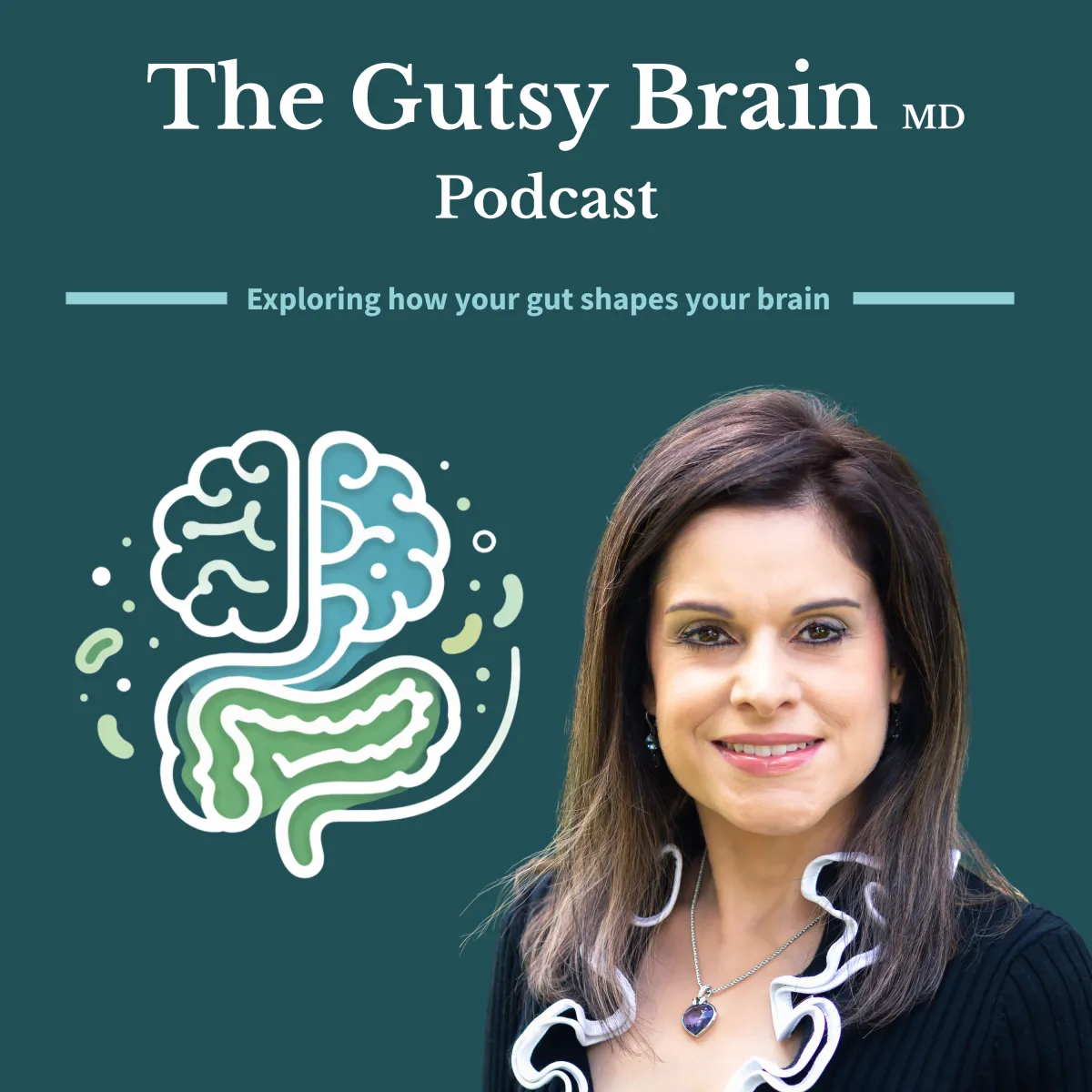
The Gut May Be the Missing Piece of Brain Health.
Hosted by:
Dr. Rana Mafee, MD
The Gut May Be the Missing Piece of Brain Health.
Hosted by:
Dr. Rana Mafee, MD
The Body Whispers Before It Screams:
How Healing My Chronically Diseased Gut Helped Put My Psoriatic Arthritis Into Remission After Cancer
The Body Whispers Before It Screams:
How Healing My Chronically Diseased Gut Helped Put My Psoriatic Arthritis Into Remission After Cancer
What happens when the physician becomes the patient?
In this deeply personal episode of The Gutsy Brain MD, Dr. Rana Mafee shares the health journey that changed not only her life—but the way she practices medicine.
Long before her cancer diagnosis, there were clues. Five autoimmune diseases. A severe gastrointestinal infection that never fully resolved. Persistent digestive symptoms. Worsening psoriasis. Anxiety. Brain fog. And treatment after treatment that seemed to help—only for the symptoms to return.
Then, in 2024, everything changed. Dr. Mafee was diagnosed with a rare soft tissue sarcoma, underwent a radical knee replacement, and completed six months of intensive chemotherapy. Modern medicine saved her life—but when cancer treatment ended, she still wasn't well.
Her gastrointestinal symptoms persisted. Her psoriasis worsened. And debilitating pain in her hips and sacroiliac joints developed that turned out to be psoriatic arthritis. What happened next would profoundly change the way she thought about chronic disease.
As she began more aggressively addressing persistent gastrointestinal infections and other factors she believed were contributing to her illness, her joint pain disappeared, her psoriasis began to clear, and her digestive health finally began to normalize.
In this episode, Dr. Mafee shares the full story—including what she knows, what she doesn't know, and why her experience taught her to keep asking one of the most important questions in medicine:
Why?
Why did this disease develop?
What was happening in the months or years before the diagnosis?
And could the symptoms we often try to silence actually be clues pointing us toward something deeper?
This isn't a story about one magic treatment or a universal protocol. It's a story about chronic illness, resilience, modern medicine, the gut-immune connection, and learning to listen when the body whispers.
Key Takeaways:
• Chronic disease often has a story that begins long before the diagnosis.
Autoimmune disease, digestive symptoms, skin changes, metabolic dysfunction, chronic inflammation, and other seemingly disconnected problems may sometimes represent pieces of a much larger biological story.
• Normal testing doesn't always mean someone is well.
Dr. Mafee's endoscopy and colonoscopy were normal even as she struggled with significant gastrointestinal symptoms, loss of appetite, nausea, weight loss, anxiety, and brain fog. A normal test can be reassuring—but it doesn't invalidate persistent symptoms.
• The gut doesn't exist in isolation.
The gastrointestinal tract interacts with the immune system, nervous system, hormones, metabolism, and other systems throughout the body. Dr. Mafee's experience reinforced the importance of looking beyond the gut when evaluating chronic digestive dysfunction—and looking toward the gut when symptoms appear elsewhere in the body.
• Recurrent symptoms may be a reason to keep asking why.
For years, treatments would make Dr. Mafee feel 50–70% better, only for her symptoms to return. Her experience taught her not to simply ask, “How do I treat this symptom?” but also, “What might be allowing this problem to keep coming back?”
• Survival and healing aren't always the same thing.
Cancer surgery and chemotherapy saved Dr. Mafee's life. But finishing cancer treatment did not immediately restore her health. Her experience taught her that lifesaving conventional medicine and a broader approach to rebuilding health don't have to be opposing philosophies.
• Healing is rarely about one “magic” intervention.
There was no single supplement, medication, diet, or laboratory test that explained Dr. Mafee's recovery. Healing happened layer by layer and included addressing infections, inflammation, the microbiome, nutrition, sleep, stress, movement, and giving her body time to recover.
• One person's experience is not a universal protocol.
Dr. Mafee's story does not mean that everyone with psoriasis, psoriatic arthritis, autoimmune disease, or cancer has chronic gastrointestinal infections. Complex diseases can have many contributors, and each patient deserves an individualized evaluation.
• Symptoms can be information.
Rather than viewing every symptom simply as something to suppress, this journey taught Dr. Mafee to also ask what that symptom might be communicating about the body's underlying physiology.
• Becoming a patient changed the way Dr. Mafee practices medicine.
There is a difference between understanding chronic illness intellectually and experiencing it personally. Living through years of unexplained symptoms, cancer treatment, autoimmune disease, and recovery reinforced the importance of listening to patients and continuing to investigate when something doesn't add up.
• Your diagnosis is not necessarily the end of your story.
A diagnosis matters. Treatment matters. Modern medicine matters. But there may still be opportunities to improve the biological environment in which health and disease unfold.
If this episode resonates with you, please share it with someone who may need to hear it.
Sometimes knowing that someone else kept searching—and eventually began finding their way back to health—is exactly what we need to hear.
Stay curious. Protect your gut. Protect your brain. And never stop asking why.
Subscribe to The Gutsy Brain MD Podcast so you don't miss it.
Sign up for my newsletter to never miss a beat, get transcripts of episodes and get all the latest updates on upcoming podcast Episodes!
*DISCLAIMER: This podcast is for information purposes only. The content in this podcast and on this webpage is not intended to be a substitute for professional medical advice, diagnosis, or treatment. Always seek the advice of your doctor or qualified healthcare provider. Never disregard professional medical advice or delay in seeking it because of something you have heard on my content or website.

Want to connect?
Learn more about Dr. Rana here!
General questions?
Facebook
Instagram
LinkedIn